

LangNation
Courses Browse courses Regular One-to-one Intensive Placement test
Exams Exam papers Study material Einbürgerungstest
Germany Living and studying in Germany Study in Germany The German school system Your first weeks Working in Germany
Tools German grade ECTS credits Overall band TOEFL ⇄ IELTS converter
About us About Events Gallery Blog FAQ
Contact Request a call back Deutsch
  1. Frage 121 Geschichte und Verantwortung

    Eine Partei möchte in den Deutschen Bundestag. Sie muss aber einen Mindestanteil an Wählerstimmen haben. Das heißt …

    1. 5%-Hürde. richtig
    2. Zulassungsgrenze.
    3. Basiswert.
    4. Richtlinie.
    In English

    A party wants to enter the German Bundestag. But it must have a minimum share of the votes. That is called the …

    1. A 5% threshold.
    2. B admission limit.
    3. C base value.
    4. D guideline.

    Unofficial translation, to help you read the question. Only the German wording counts in the exam.

    Warum? Der Mindestanteil heißt 5%-Hürde oder Sperrklausel.
  2. Frage 122 Geschichte und Verantwortung

    Welchem Grundsatz unterliegen Wahlen in Deutschland? Wahlen in Deutschland sind …

    1. frei, gleich, geheim. richtig
    2. offen, sicher, frei.
    3. geschlossen, gleich, sicher.
    4. sicher, offen, freiwillig.
    In English

    Which principles govern elections in Germany? Elections in Germany are …

    1. A free, equal, secret.
    2. B open, safe, free.
    3. C closed, equal, safe.
    4. D safe, open, voluntary.

    Unofficial translation, to help you read the question. Only the German wording counts in the exam.

    Warum? Aus den fünf Wahlrechtsgrundsätzen des Grundgesetzes: allgemein, unmittelbar, frei, gleich, geheim. Art. 38 GG

  3. Frage 123 Geschichte und Verantwortung

    Was ist in Deutschland die "5%-Hürde"?

    1. Abstimmungsregelung im Bundestag für kleine Parteien
    2. Anwesenheitskontrolle im Bundestag für Abstimmungen
    3. Mindestanteil an Wählerstimmen, um ins Parlament zu kommen richtig
    4. Anwesenheitskontrolle im Bundesrat für Abstimmungen
    In English

    What is the "5% threshold" in Germany?

    1. A a voting rule in the Bundestag for small parties
    2. B an attendance check in the Bundestag for votes
    3. C the minimum share of votes needed to enter parliament
    4. D an attendance check in the Bundesrat for votes

    Unofficial translation, to help you read the question. Only the German wording counts in the exam.

    Warum? Die 5%-Hürde ist der Mindestanteil an Zweitstimmen, den eine Partei für den Einzug ins Parlament braucht.

  4. Frage 124 Geschichte und Verantwortung

    Die Bundestagswahl in Deutschland ist die Wahl …

    1. der Bundeskanzlerin/des Bundeskanzlers.
    2. der Parlamente der Länder.
    3. des Parlaments für Deutschland. richtig
    4. der Bundespräsidentin/des Bundespräsidenten.
    In English

    The federal election in Germany is the election of …

    1. A the Federal Chancellor.
    2. B the parliaments of the Bundesländer.
    3. C the parliament for Germany.
    4. D the Federal President.

    Unofficial translation, to help you read the question. Only the German wording counts in the exam.

    Warum? Bei der Bundestagswahl wird das Parlament gewählt. Die Kanzlerin oder den Kanzler wählt danach der Bundestag.

  5. Frage 125 Geschichte und Verantwortung

    In einer Demokratie ist eine Funktion von regelmäßigen Wahlen, …

    1. die Bürgerinnen und Bürger zu zwingen, ihre Stimme abzugeben.
    2. nach dem Willen der Wählermehrheit den Wechsel der Regierung zu ermöglichen. richtig
    3. im Land bestehende Gesetze beizubehalten.
    4. den Armen mehr Macht zu geben.
    In English

    In a democracy, one function of regular elections is …

    1. A to force citizens to cast their vote.
    2. B to make a change of government possible according to the will of the majority of voters.
    3. C to keep the country's existing laws in place.
    4. D to give the poor more power.

    Unofficial translation, to help you read the question. Only the German wording counts in the exam.

    Warum? Wahlen machen einen Regierungswechsel ohne Gewalt möglich. Das ist der Unterschied zur Diktatur.

  6. Frage 126 Geschichte und Verantwortung

    Was bekommen wahlberechtigte Bürgerinnen und Bürger in Deutschland vor einer Wahl?

    1. eine Wahlbenachrichtigung von der Gemeinde richtig
    2. eine Wahlerlaubnis von der Bundespräsidentin/von dem Bundespräsidenten
    3. eine Benachrichtigung von der Bundesversammlung
    4. eine Benachrichtigung vom Pfarramt
    In English

    What do citizens entitled to vote receive in Germany before an election?

    1. A a polling card from the municipality
    2. B permission to vote from the Federal President
    3. C a notification from the Federal Convention
    4. D a notification from the parish office

    Unofficial translation, to help you read the question. Only the German wording counts in the exam.

    Warum? Die Gemeinde schickt eine Wahlbenachrichtigung mit Wahllokal und Öffnungszeiten. Wählen kann man auch ohne sie, mit Ausweis.

  7. Frage 127 Geschichte und Verantwortung

    Warum gibt es die 5%-Hürde im Wahlgesetz der Bundesrepublik Deutschland? Es gibt sie, weil …

    1. die Programme von vielen kleinen Parteien viele Gemeinsamkeiten haben.
    2. die Bürgerinnen und Bürger bei vielen kleinen Parteien die Orientierung verlieren können.
    3. viele kleine Parteien die Regierungsbildung erschweren. richtig
    4. die kleinen Parteien nicht so viel Geld haben, um die Politikerinnen und Politiker zu bezahlen.
    In English

    Why does the electoral law of the Federal Republic of Germany have a 5% threshold? It exists because …

    1. A the programmes of many small parties have a great deal in common.
    2. B citizens can lose their bearings when there are many small parties.
    3. C many small parties make forming a government difficult.
    4. D small parties do not have enough money to pay their politicians.

    Unofficial translation, to help you read the question. Only the German wording counts in the exam.

    Warum? Ohne Sperrklausel kämen sehr viele kleine Parteien ins Parlament, und eine Mehrheit für eine Regierung wäre kaum zu bilden. Das ist der Grund für die Hürde.

  8. Frage 128 Geschichte und Verantwortung

    Parlamentsmitglieder, die von den Bürgerinnen und Bürgern gewählt werden, nennt man …

    1. Abgeordnete. richtig
    2. Kanzlerinnen/Kanzler.
    3. Botschafterinnen/Botschafter.
    4. Ministerpräsidentinnen/Ministerpräsidenten.
    In English

    Members of parliament elected by the citizens are called …

    1. A Abgeordnete (members of parliament).
    2. B Chancellors.
    3. C ambassadors.
    4. D Minister-Presidents.

    Unofficial translation, to help you read the question. Only the German wording counts in the exam.

    Warum? Gewählte Parlamentsmitglieder heißen Abgeordnete — im Bundestag wie im Landtag.

  9. Frage 129 Geschichte und Verantwortung

    Vom Volk gewählt wird in Deutschland …

    1. die Bundeskanzlerin/der Bundeskanzler.
    2. die Ministerpräsidentin/der Ministerpräsident eines Bundeslandes.
    3. der Bundestag. richtig
    4. die Bundespräsidentin/der Bundespräsident.
    In English

    In Germany, the following is elected by the people: …

    1. A the Federal Chancellor.
    2. B the Minister-President of a Bundesland.
    3. C the Bundestag.
    4. D the Federal President.

    Unofficial translation, to help you read the question. Only the German wording counts in the exam.

    Warum? Direkt gewählt wird nur der Bundestag. Kanzler, Bundespräsident und Ministerpräsidenten werden von Parlamenten gewählt.

  10. Frage 130 Geschichte und Verantwortung

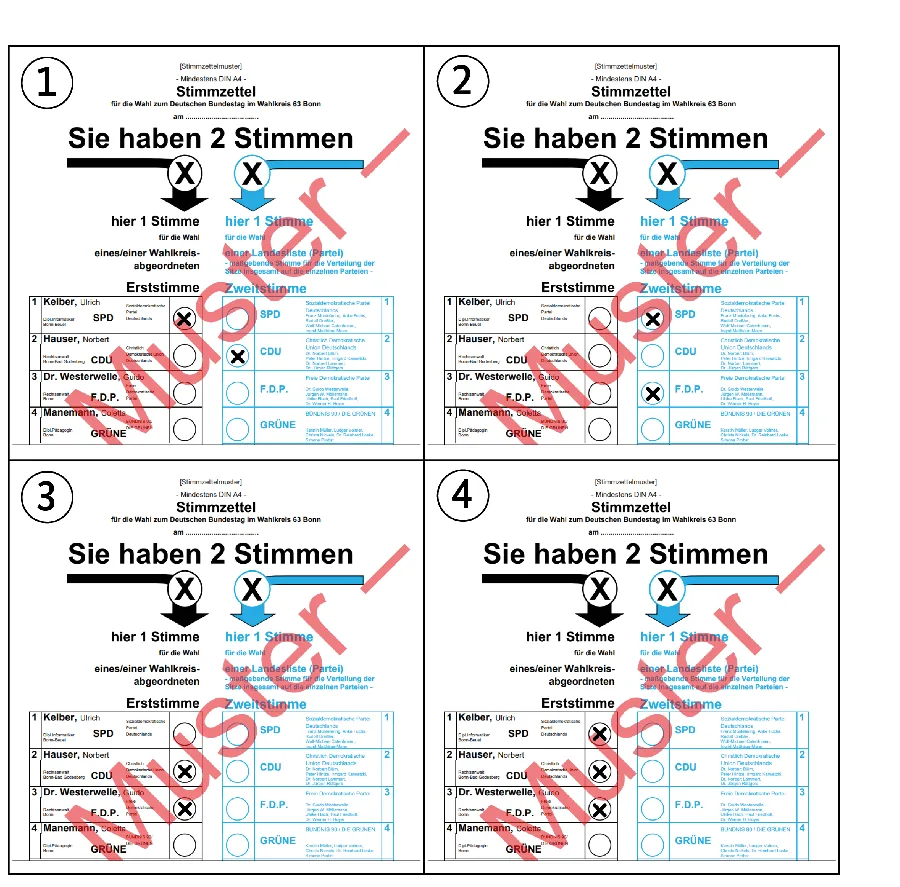
    Welcher Stimmzettel wäre bei einer Bundestagswahl gültig? In Anlehnung an Bundeswahlordnung (BWO), Anlage 26

    Abbildung zu Frage 130
    1. 1 richtig
    2. 2
    3. 3
    4. 4
    In English

    Which ballot paper would be valid at a federal election? Based on the Federal Electoral Regulations (BWO), Annex 26

    1. A 1
    2. B 2
    3. C 3
    4. D 4

    Unofficial translation, to help you read the question. Only the German wording counts in the exam.

    Warum? Gültig ist ein Stimmzettel mit höchstens einem Kreuz je Spalte. Zwei Kreuze in derselben Spalte, Text oder ein durchgestrichener Zettel machen ihn ungültig.

  11. Frage 131 Geschichte und Verantwortung

    In Deutschland ist eine Bürgermeisterin/ein Bürgermeister …

    1. die Leiterin/der Leiter einer Schule.
    2. die Chefin/der Chef einer Bank.
    3. das Oberhaupt einer Gemeinde. richtig
    4. die/der Vorsitzende einer Partei.
    In English

    In Germany, a mayor is …

    1. A the head of a school.
    2. B the head of a bank.
    3. C the head of a municipality.
    4. D the chair of a party.

    Unofficial translation, to help you read the question. Only the German wording counts in the exam.

    Warum? Die Bürgermeisterin oder der Bürgermeister steht an der Spitze einer Gemeinde und wird meist direkt von den Einwohnerinnen und Einwohnern gewählt.

  12. Frage 132 Geschichte und Verantwortung

    Viele Menschen in Deutschland arbeiten in ihrer Freizeit ehrenamtlich. Was bedeutet das?

    1. Sie arbeiten als Soldatinnen/Soldaten.
    2. Sie arbeiten freiwillig und unbezahlt in Vereinen und Verbänden. richtig
    3. Sie arbeiten in der Bundesregierung.
    4. Sie arbeiten in einem Krankenhaus und verdienen dabei Geld.
    In English

    Many people in Germany do voluntary work in their free time. What does that mean?

    1. A They work as soldiers.
    2. B They work voluntarily and unpaid in clubs and associations.
    3. C They work in the federal government.
    4. D They work in a hospital and earn money doing it.

    Unofficial translation, to help you read the question. Only the German wording counts in the exam.

    Warum? Ehrenamtlich heißt freiwillig und unbezahlt — in Vereinen, bei der Feuerwehr, in Verbänden. Millionen Menschen in Deutschland tun das.

  13. Frage 133 Geschichte und Verantwortung

    Was ist bei Bundestags- und Landtagswahlen in Deutschland erlaubt?

    1. Der Ehemann wählt für seine Frau mit.
    2. Man kann durch Briefwahl seine Stimme abgeben. richtig
    3. Man kann am Wahltag telefonisch seine Stimme abgeben.
    4. Kinder ab dem Alter von 14 Jahren dürfen wählen.
    In English

    What is allowed at federal and state elections in Germany?

    1. A A husband votes on behalf of his wife as well.
    2. B You can cast your vote by postal ballot.
    3. C You can cast your vote by telephone on polling day.
    4. D Children from the age of 14 may vote.

    Unofficial translation, to help you read the question. Only the German wording counts in the exam.

    Warum? Briefwahl ist erlaubt und braucht keinen Grund. Telefonisch oder für jemand anderen zu wählen ist dagegen nicht möglich.

  14. Frage 134 Geschichte und Verantwortung

    Man will die Buslinie abschaffen, mit der Sie immer zur Arbeit fahren. Was können Sie machen, um die Buslinie zu erhalten?

    1. Ich beteilige mich an einer Bürgerinitiative für die Erhaltung der Buslinie oder gründe selber eine Initiative. richtig
    2. Ich werde Mitglied in einem Sportverein und trainiere Radfahren.
    3. Ich wende mich an das Finanzamt, weil ich als Steuerzahlerin/Steuerzahler ein Recht auf die Buslinie habe.
    4. Ich schreibe einen Brief an das Forstamt der Gemeinde.
    In English

    There are plans to scrap the bus route you always take to work. What can you do to keep the route?

    1. A I take part in a citizens' initiative to keep the bus route, or start one myself.
    2. B I join a sports club and train as a cyclist.
    3. C I contact the tax office, because as a taxpayer I have a right to the bus route.
    4. D I write a letter to the municipal forestry office.

    Unofficial translation, to help you read the question. Only the German wording counts in the exam.

    Warum? Eine Bürgerinitiative ist der übliche Weg, ein örtliches Anliegen an die Gemeinde zu tragen. Dafür braucht man keine Partei und keinen Verein.

  15. Frage 135 Geschichte und Verantwortung

    Wen vertreten die Gewerkschaften in Deutschland?

    1. große Unternehmen
    2. kleine Unternehmen
    3. Selbstständige
    4. Arbeitnehmerinnen und Arbeitnehmer richtig
    In English

    Who do trade unions represent in Germany?

    1. A large companies
    2. B small companies
    3. C self-employed people
    4. D employees

    Unofficial translation, to help you read the question. Only the German wording counts in the exam.

    Warum? Gewerkschaften sind die Interessenvertretung der Arbeitnehmerinnen und Arbeitnehmer.

  16. Frage 136 Geschichte und Verantwortung

    Sie gehen in Deutschland zum Arbeitsgericht bei …

    1. falscher Nebenkostenabrechnung.
    2. ungerechtfertigter Kündigung durch Ihre Chefin/Ihren Chef. richtig
    3. Problemen mit den Nachbarinnen/Nachbarn.
    4. Schwierigkeiten nach einem Verkehrsunfall.
    In English

    In Germany you go to the labour court in the case of …

    1. A an incorrect service-charge statement.
    2. B unfair dismissal by your boss.
    3. C problems with the neighbours.
    4. D difficulties after a road accident.

    Unofficial translation, to help you read the question. Only the German wording counts in the exam.

    Warum? Für Streit zwischen Arbeitgeber und Arbeitnehmer ist das Arbeitsgericht zuständig — auch bei einer Kündigung.

  17. Frage 137 Geschichte und Verantwortung

    Welches Gericht ist in Deutschland bei Konflikten in der Arbeitswelt zuständig?

    1. das Familiengericht
    2. das Strafgericht
    3. das Arbeitsgericht richtig
    4. das Amtsgericht
    In English

    Which court in Germany deals with disputes at work?

    1. A the family court
    2. B the criminal court
    3. C the labour court
    4. D the local court

    Unofficial translation, to help you read the question. Only the German wording counts in the exam.

    Warum? Das Arbeitsgericht. Für Miete gilt das Amtsgericht, für Scheidungen das Familiengericht.

  18. Frage 138 Geschichte und Verantwortung

    Was kann ich in Deutschland machen, wenn mir meine Arbeitgeberin/mein Arbeitgeber zu Unrecht gekündigt hat?

    1. weiterarbeiten und freundlich zur Chefin/zum Chef sein
    2. ein Mahnverfahren gegen die Arbeitgeberin/den Arbeitgeber führen
    3. Kündigungsschutzklage erheben richtig
    4. die Arbeitgeberin/den Arbeitgeber bei der Polizei anzeigen
    In English

    What can I do in Germany if my employer has dismissed me unfairly?

    1. A carry on working and be friendly to the boss
    2. B start debt-collection proceedings against the employer
    3. C bring an unfair-dismissal claim
    4. D report the employer to the police

    Unofficial translation, to help you read the question. Only the German wording counts in the exam.

    Warum? Gegen eine Kündigung klagt man beim Arbeitsgericht — und zwar innerhalb von drei Wochen, sonst gilt sie als wirksam. § 4 KSchG

  19. Frage 139 Geschichte und Verantwortung

    Wann kommt es in Deutschland zu einem Prozess vor Gericht? Wenn jemand …

    1. zu einer anderen Religion übertritt.
    2. eine Straftat begangen hat und angeklagt wird. richtig
    3. eine andere Meinung als die der Regierung vertritt.
    4. sein Auto falsch geparkt hat und es abgeschleppt wird.
    In English

    When does a case come to court in Germany? When somebody …

    1. A converts to another religion.
    2. B has committed an offence and is charged.
    3. C holds a different opinion from the government.
    4. D has parked their car badly and it is towed away.

    Unofficial translation, to help you read the question. Only the German wording counts in the exam.

    Warum? Zu einem Strafprozess kommt es, wenn jemand einer Straftat beschuldigt und angeklagt wird. Falschparken ist eine Ordnungswidrigkeit, kein Prozessgrund.

  20. Frage 140 Geschichte und Verantwortung

    Was macht eine Schöffin/ein Schöffe in Deutschland? Sie/Er …

    1. entscheidet mit Richterinnen/Richtern über Schuld und Strafe. richtig
    2. gibt Bürgerinnen/Bürgern rechtlichen Rat.
    3. stellt Urkunden aus.
    4. verteidigt die Angeklagte/den Angeklagten.
    In English

    What does a lay judge (Schöffe) do in Germany? He or she …

    1. A decides on guilt and sentence together with the professional judges.
    2. B gives citizens legal advice.
    3. C issues official documents.
    4. D defends the accused.

    Unofficial translation, to help you read the question. Only the German wording counts in the exam.

    Warum? Schöffinnen und Schöffen sind Laien und entscheiden gemeinsam mit den Berufsrichtern über Schuld und Strafe. Ihre Stimme zählt gleich viel.

  21. Frage 141 Geschichte und Verantwortung

    Wer berät in Deutschland Personen bei Rechtsfragen und vertritt sie vor Gericht?

    1. eine Rechtsanwältin/ein Rechtsanwalt richtig
    2. eine Richterin/ein Richter
    3. eine Schöffin/ein Schöffe
    4. eine Staatsanwältin/ein Staatsanwalt
    In English

    In Germany, who advises people on legal questions and represents them in court?

    1. A a lawyer (Rechtsanwalt)
    2. B a judge
    3. C a lay judge (Schöffe)
    4. D a public prosecutor

    Unofficial translation, to help you read the question. Only the German wording counts in the exam.

    Warum? Rechtsanwältinnen und Rechtsanwälte beraten und vertreten. Richterinnen und Richter entscheiden, die Staatsanwaltschaft klagt an.

  22. Frage 142 Geschichte und Verantwortung

    Was ist die Hauptaufgabe einer Richterin/eines Richters in Deutschland? Eine Richterin/ein Richter …

    1. vertritt Bürgerinnen und Bürger vor einem Gericht.
    2. arbeitet an einem Gericht und spricht Urteile. richtig
    3. ändert Gesetze.
    4. betreut Jugendliche vor Gericht.
    In English

    What is the main task of a judge in Germany? A judge …

    1. A represents citizens in court.
    2. B works at a court and delivers judgments.
    3. C changes laws.
    4. D looks after young people in court.

    Unofficial translation, to help you read the question. Only the German wording counts in the exam.

    Warum? Richterinnen und Richter sprechen Urteile und sind dabei unabhängig — nur dem Gesetz unterworfen. Art. 97 GG

  23. Frage 143 Geschichte und Verantwortung

    Eine Richterin/ein Richter in Deutschland gehört zur …

    1. Judikative. richtig
    2. Exekutive.
    3. Operative.
    4. Legislative.
    In English

    A judge in Germany belongs to the …

    1. A judiciary.
    2. B executive.
    3. C "operative".
    4. D legislature.

    Unofficial translation, to help you read the question. Only the German wording counts in the exam.

    Warum? Judikative ist die rechtsprechende Gewalt. Exekutive ist die ausführende, Legislative die gesetzgebende.

  24. Frage 144 Geschichte und Verantwortung

    Eine Richterin/ein Richter gehört in Deutschland zur …

    1. vollziehenden Gewalt.
    2. rechtsprechenden Gewalt. richtig
    3. planenden Gewalt.
    4. gesetzgebenden Gewalt.
    In English

    In Germany a judge belongs to the …

    1. A executive power.
    2. B judicial power.
    3. C planning power.
    4. D legislative power.

    Unofficial translation, to help you read the question. Only the German wording counts in the exam.

    Warum? Wie Nr. 143, nur auf Deutsch statt auf Latein: die rechtsprechende Gewalt.

  25. Frage 145 Geschichte und Verantwortung

    In Deutschland wird die Staatsgewalt geteilt. Für welche Staatsgewalt arbeitet eine Richterin/ein Richter? Für die …

    1. Judikative richtig
    2. Exekutive
    3. Presse
    4. Legislative
    In English

    In Germany, state power is divided. Which branch does a judge work for? The …

    1. A judiciary
    2. B executive
    3. C press
    4. D legislature

    Unofficial translation, to help you read the question. Only the German wording counts in the exam.

    Warum? Für die Judikative. Sie ist von Regierung und Parlament getrennt, damit Urteile nicht von der Politik abhängen.

  26. Frage 146 Geschichte und Verantwortung

    Wie nennt man in Deutschland ein Verfahren vor einem Gericht?

    1. Programm
    2. Prozedur
    3. Protokoll
    4. Prozess richtig
    In English

    What are proceedings before a court called in Germany?

    1. A Programm
    2. B Prozedur
    3. C Protokoll
    4. D Prozess (trial)

    Unofficial translation, to help you read the question. Only the German wording counts in the exam.

    Warum? Ein gerichtliches Verfahren heißt Prozess.

  27. Frage 147 Geschichte und Verantwortung

    Was ist die Arbeit einer Richterin/eines Richters in Deutschland?

    1. Deutschland regieren
    2. Recht sprechen richtig
    3. Pläne erstellen
    4. Gesetze erlassen
    In English

    What is a judge's work in Germany?

    1. A governing Germany
    2. B administering justice
    3. C drawing up plans
    4. D enacting laws

    Unofficial translation, to help you read the question. Only the German wording counts in the exam.

    Warum? Recht sprechen: den Fall anhören und entscheiden. Gesetze machen dürfen Richterinnen und Richter nicht.

  28. Frage 148 Geschichte und Verantwortung

    Was ist eine Aufgabe der Polizei in Deutschland?

    1. das Land zu verteidigen
    2. die Bürgerinnen und Bürger abzuhören
    3. die Gesetze zu beschließen
    4. die Einhaltung von Gesetzen zu überwachen richtig
    In English

    What is one task of the police in Germany?

    1. A defending the country
    2. B eavesdropping on citizens
    3. C passing the laws
    4. D making sure the laws are obeyed

    Unofficial translation, to help you read the question. Only the German wording counts in the exam.

    Warum? Die Polizei überwacht die Einhaltung der Gesetze und schützt die Bürgerinnen und Bürger. Das Land verteidigt die Bundeswehr.

  29. Frage 149 Geschichte und Verantwortung

    Was ist ein Beispiel für antisemitisches Verhalten?

    1. ein jüdisches Fest besuchen
    2. die israelische Regierung kritisieren
    3. den Holocaust leugnen richtig
    4. gegen Juden Fußball spielen.
    In English

    Which of these is an example of antisemitic behaviour?

    1. A attending a Jewish festival
    2. B criticising the Israeli government
    3. C denying the Holocaust
    4. D playing football against Jews

    Unofficial translation, to help you read the question. Only the German wording counts in the exam.

    Warum? Antisemitismus ist Feindschaft gegen Juden als Juden. Die Leugnung des Holocaust gehört dazu und ist strafbar; Kritik an einer Regierung nicht.

  30. Frage 150 Geschichte und Verantwortung

    Eine Gerichtsschöffin/ein Gerichtsschöffe in Deutschland ist …

    1. die Stellvertreterin/der Stellvertreter des Stadtoberhaupts.
    2. eine ehrenamtliche Richterin/ein ehrenamtlicher Richter. richtig
    3. ein Mitglied eines Gemeinderats.
    4. eine Person, die Jura studiert hat.
    In English

    A lay judge (Schöffe) in Germany is …

    1. A the deputy head of a town.
    2. B a volunteer judge.
    3. C a member of a municipal council.
    4. D a person who has studied law.

    Unofficial translation, to help you read the question. Only the German wording counts in the exam.

    Warum? Schöffin oder Schöffe ist ein Ehrenamt. Man braucht kein Jurastudium und wird für fünf Jahre berufen.

Fragen und Abbildungen aus dem amtlichen Gesamtfragenkatalog des Bundesamtes für Migration und Flüchtlinge, Stand 2025-05-07. LangNation ist ein unabhängiges Lernangebot und steht nicht in Verbindung mit dem Bundesamt für Migration und Flüchtlinge.